Algebra I Recipe: Square Roots
By G Redden
 A. Definitions
- square rooting a number – finding the number that when multiplied by itself equals the number being square rooted.
- perfect squares – numbers that can be square rooted evenly like 4, 9, 16, 25, 36, 49, 64, 81, 100, 121, 144, 169, 196, 225, . . .
4 = 2 because 2 • 2 = 4, BUT it could also be = -2 because –2 • -2 = 4.
25 = 5 because 5 • 5 = 25, BUT it could also be = -5 because –5 • -5 = 25.
means to give the positive square root or answer.
81 = 9
- -
means to give the negative square root or answer. -
49 = -7
- ±
means to give the positive AND negative square root or answer. ±
25 = ± 5
 B. Evaluating the Expression
  where a = 1, b = -2, c = -3
- Substitute the values.
- Follow order of operations to find the value of the expression under the
.
- Find the square root of the number.
- You cannot find the square root of a negative number.
 C. Evaluating an Expression like
- Make two problems.
- One with only the +
- One with only the -
- Use order of operations to find the two values.
- Round the
to the nearest hundredth when it cannot be square rooted evenly.
 D. Pythagorean Theorem Right Triangle
- Pythagorean Theorem is a² + b² = c².
- The Pythagorean Theorem is used to find any missing side of a right triangle, when the other two lengths are known. It is also used to determine if three particular lengths would form a right triangle.
- "a" and "b" are the legs that form the right angle.
- "c" is the hypotenuse.
Find the missing value in the triangle shown below.
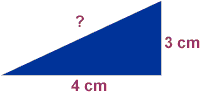
Find the missing value in the triangle shown below.
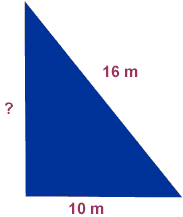

Advertisement