Word Lesson: Modeling with Sinusoids 1
By M Ransom
- use basic graphing skills for sine and cosine
- know how to find amplitude, period, and frequency
- solve equations requiring the use of inverse sine and cosine: arccos(x) or cos-1(x) and arcsin(x) or sin-1(x)
Suppose a particle moves along the x-axis. Its position (x-coordinate) at any time t seconds where t is greater than or equal to zero is given by  . (a) What is the position of the particle at time t = 2.3 seconds? (b) What are the amplitude, period and frequency of this motion? (c) What is the smallest value of x that the particle reaches during its motion?
(a) To find the position of the particle at t = 2.3 we evaluateNote that this tell us the x-coordinate of the particle at t = 2.3.(b) The amplitude is given as 2, the leading coefficient in the original equation
.
The frequency can be found by rewriting the expression
.
From this we see thatSince
we can determine that the period is
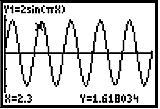
T = 2 seconds.(c) The maximum distance this particle moves can be seen easily if we note that at time t = 0 the particle is at the coordinate x = 0. We call this the stable (equilibrium) position of the particle since it moves to the left and right of this position, which acts as a center of the motion. Since the amplitude of the motion is 2, the particle moves from the origin at most a distance of 2. This means the smallest value of x that the particle reaches is x = -2. The particle moves back and forth between the x-coordinates -2 and +2 in a period of 2 seconds. A graph of the position of this particle is shown below over a 10 second time interval.
Remember that the calculator uses X instead of t. So the expression Y1=2sin(pX) really represents Y1=2sin(pt) or the values for our function s(t). That is, the values of Y1 are the x-coordinates of the particle's position as it moves along the x-axis. Notice that at time t = 2.3 the particle's approximate position, or x-coordinate, is 1.618.



An object attached to a spring oscillates around a stable (equilibrium) position according to the position formula given by s(t) = 8sin(3t) where t is in seconds and s(t) is in feet. What are the period, frequency and the maximum displacement from the stable (equilibrium) position?
An object hangs from a spring in a stable (equilibrium) position. The spring is pulled 3 feet downward and the object begins to oscillate, making one complete oscillation every 4 seconds. What is an equation of the motion of this object?
A particle travels along the x-axis according to the position s(t) = 7sin(3pt) where t is in seconds and s is the x-coordinate of the particle. (a) What is the x-coordinate of the particle at time t = 7.4 seconds? (b) What is the largest value for the x-coordinate giving position of the particle. (c) What is the frequency of this motion?
- x-coordinate 6.5671, largest value 7, frequency = 3/2
- x-coordinate is 4.1145, largest value is 7, and frequency is 3/2
- x-coordinate is 4.1145, largest value is 14, and frequency is 3/2
- x-coordinate is 4.1145, largest value is 7, and frequency is 2/3
A weight attached to a spring is pulled down 14 centimeters from its equilibrium point. Assuming that the frequency of the resulting oscillation is 5/p, what is an expression using cosine which describes the motion of this weight?




This type of problem requires a thorough knowledge of the equation s(t) = Asin(2pft). It is often easier to obtain the value of A, the amplitude, first. The value of f can be found by determining the period, or time interval required for the motion of the object to travel once through all possible positions. It is also important to remember that f = 1/period, that is, the frequency is the reciprocal of the period. Notice that depending upon which information we know, these problems can require as few as two steps, or as many as four steps to solve.