Mr. Ferris' Rides
By J Burch
Mr. Ferris has an idea for a new type of amusement ride. It will be a giant "wheel" on which people can ride in seats suspended along its perimeter. His initial concept is to use a wheel that has a radius of 10 meters with its bottom standing 1 meter off of the ground. The wheel will spin at 0.5 revolutions per minute.
Directions and/or Common Information:
In analyzing this problem, our first task is to create a graph of the movement of the Ferris wheel. We know from physics that the standard equation for this type of motion, called SHM or Simple Harmonic Motion, is given by
s = a sin(2pft + f) + s0
where- s = displacement
- a = amplitude
- f = frequency
- t = time
- f = rotation shift
- s0 = height of the center of the circle
Note: The calculator must be in radians mode for this exercise. See Fig I.1 below.
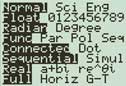
Fig I.1
- a = 10 meters
- f = 1/120 rev/sec
- f = - p /2
- s0 = 11 meters
We are using f = - p /2
because the passengers will be embarking at the bottom of the wheel, rather than the right edge.
Another way of writing f = - p /2
is to replace the function sine with the function -cosine. Using this function, the equation for our Ferris wheel would become
y = -10 cos(px/60) + 11
Now, enter the equation into the Y= menu. Remember that the

and

keys perform different functions. Be sure that you use the correct one. Your window should look like Fig I.2 shown below. If you need help in graphing functions, see the lesson on graphing with the TI calculator.
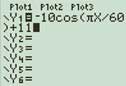
Fig I.2
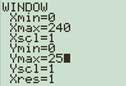
Fig I.3
Describe what the graph of the Ferris wheel looks like on your calculator screen.
Directions and/or Common Information:
One day, Mr. Ferris decided to upgrade his Ferris wheel, but forgot to give you the updated specs. To determine the changes, you decide to ride the wheel and take some measurements which are listed in the following table. (Fig II.1)
| time | height |
| 0 s | 2 m |
| 45 s | 13.5 m |
| 90 s | 25 m |
| 135 s | 13.5 m |
| 180 s | 2 m |
Fig II.1 Enter the data into the calculator lists. Entering data into lists is discussed in the graphing calculator lesson called Data Input. Please refer to it if you have trouble with this section). After the data is entered (Fig II.2),
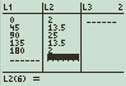
Fig II.2
 ,
select the last item on the list, C: SinReg (Fig II.3), and press enter twice.
,
select the last item on the list, C: SinReg (Fig II.3), and press enter twice.
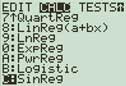
Fig II.3
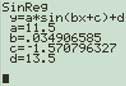
Fig II.4
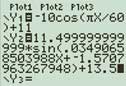
Fig II.5
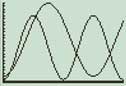
Fig II.6
What the exact equation for his new Ferris wheel's motion?
Directions and/or Common Information:
Mr. Ferris has once again decided to change his wheel. Instead of having his passengers embark at the bottom of the wheel, they will now get on after the wheel has completed an 8th of a turn with respect to the original lowest position - the bottom of the circle.
Since - p /2 equals one 4th of a turn, an 8th of a turn would be represented by - p /4. The new equation for the wheel's behavior could be written as either
y = - 11.5 cos(px/90 + p /4) + 13.5
or
y = 11.5 sin(px/90 - p /4) + 13.5
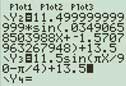
Fig III.1
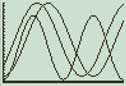
Fig III.2
According to your equation, where will a passenger be located after riding the Ferris wheel for t = 67.5 seconds?
Directions and/or Common Information:
The equations you have been looking at so far are only for the vertical motion of the Ferris wheel, however, there is also horizontal motion to be taken into account. This is actually much more simple than it may initially seem. All that is required is a 4th of a turn of the wheel. When embarking on the Ferris wheel from the same point, you would already be a little past the midpoint of the horizontal movement, and increasing toward the upper extreme of that cycle. An easy way to graph this is to simply replace sine with cosine in the equation.
Clear the top two equations from the Y= menu, and enter the following equation into the Y1 field:
y = 11.5 cos(px/90 - p /4) + 13.5
Of course we must remember that in our current interpretation of this event, the y in Y1 actually means the horizontal motion of the wheel as measured from the center of the wheel. See Fig IV.1 shown below. 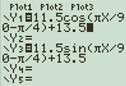
Fig IV.1
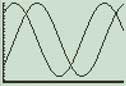
Fig IV.2
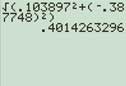
Fig IV.3
Directions and/or Common Information:
Thus far, you have been analyzing each dimension of the movement of the Ferris wheel separately. The calculator includes a mode with which to analyze two dimensional motion. This is called "Parametric Graphing." To put your calculator into Parametric mode, press
 ,
and select "Par" (Fig V.1).
,
and select "Par" (Fig V.1).
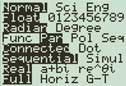
Fig V.1
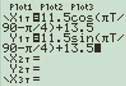
Fig V.2
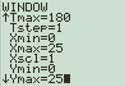
Fig V.3
Describe what your graph looks like.