Transformations of Sine and Cosine Graphs
By M Ransom
Introduction: In this lesson, the period and frequency of basic graphs of sine and cosine will be discussed and illustrated as well as vertical shift. The general sine and cosine graphs will be illustrated and applied.
The Lesson:
Let’s Practice:y = sin(x) and y = cos(x) are periodic functions because all possible y values repeat in the same sequence over a given set of x values. The “length” of this interval of x values is called the period. To refresh your memories on these periodic functions, review this lesson on their graphs.
The general form of a sine or cosine function is given in two different ways:
These functions are often shifted vertically or horizontally .


the amplitude is A the amplitude is A the vertical shift is D the vertical shift is D the period is 
the period is 
B = where f is the frequency

B = where f is the frequency



the phase shift is C the phase shift is 
- Let

Carefully inspecting the equation of f(x) tells us that
- A = 1
- B = 2
- C =

- D = 2
We can now calculate the following:
- period =

- phase shift =
.
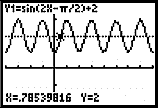
The graph of this function is shown below with a WINDOW of X:
and Y: (-2, 4, 1).

- The dotted line is Y = D = 2 and serves as the horizontal axis.
- The point plotted has coordinates
and serves as a “starting point” for a sine graph shifted
units to the right.
- Let

Carefully inspecting the equation f(x) tells us that
- A = 3
- C =
- D = -2
We can now calculate the following:
- period =

- frequency = the reciprocal of the period = 2
This can also be determined with the formula B =
.
- The phase shift is
.
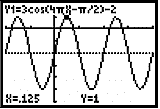
The graph of this function is shown below with a WINDOW of X:
and Y: (-6, 2, 1).
- The dotted line is the horizontal axis is Y = -2
- The point plotted is
and serves as the "starting point" for a cosine graph shifted
unit to the right.


- To experiment with the effects of changing different values of A, B, C, and D try this interactive EXCEL sheet.
Directions and/or Common Information:
For each function find its amplitude, period, frequency, vertical shift, and phase shift.Then sketch a graph of the function.


Advertisement