Period and Frequency of Sine and Cosine
By M Ransom
Introduction: In this lesson, the period and frequency of basic graphs of sine and cosine will be discussed and illustrated.
The Lesson:
Definition:y = sin(x) and y = cos(x) are periodic functions because all possible y values repeat in the same sequence over a given set of x values. The “length” of this interval of x values is called the period.
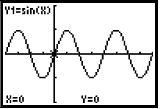
For example, if y = sin(x) the graph of this classic wave repeats over a length of
along the x-axis.
We see the same wave over and over for all real numbers x. In the graph above, you can see three complete waves.
In this graph the WINDOW is X:
and Y: (-2, 2, 1).
Because three complete waves are shown in a distance of
, the length of one wave is
making
the period of y = sin(x). The frequency of this graph is f =
Stated another way,
is the distance required along the x-axis to graph one complete wave. This means that one (1) wave will be completed every
units along the x-axis.



Let's Practice:The frequency is the reciprocal of the period.
- What are the period and frequency of y = sin(2x)?
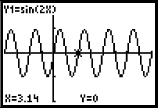
The 2 has the effect of shortening the wave length or period. Waves appear on the graph twice as frequently as in y = sin(x). The graph shown below uses a WINDOW of X:
and Y: (-2, 2, 1).
There are 6 complete waves in a distance along the x-axis of
. Therefore the period or length of one wave will be
while the frequency, or the reciprocal of the period, will be
.


- What are the period and frequency of y = cos(3x)?
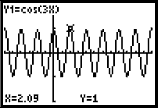
The 3 has the effect of making waves appear on the graph three times as often as y = cos(x). The graph shown below uses a WINDOW of X:
and Y: (-2, 2, 1).
There are 9 complete waves in a distance along the x-axis of
making the period
. Note that
as shown on the graph.
The frequency is the reciprocal of the period or
.
Generalizing: For either y = sin(Bx) or y = cos(Bx) the period is
. If we represent the period with the variable P, we can use the following two relationships
.



- What are the period and frequency of y =
 ?
?
Using the formula
we have period =
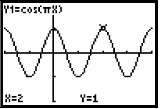
. This graph shown below uses the WINDOW X: (-2, 4, 1) and Y: (-2, 2, 1).
Notice that there are three complete waves in a distance along the x-axis of [4 - (-2)] = 6. The period can be seen from the graph as
and the frequency equals
.


- If the period of a sine function is
 , what is its equation? Describe how its graph looks.
Using the formula
we have
. Allowing us to determine that the equation is
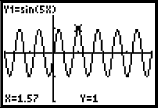
. The WINDOW for the graph shown below is X:
and Y: (-2, 2, 1).
Although it is somewhat difficult to count the number of waves on this graph, there are a total of
along the x-axis in a distance of
. The function's period of
can be determined by dividing:
.




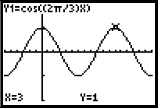
- If the period of a cosine function is 3, what is the equation? Describe how its graph looks.
Using the formula
, we have
. This allows us to write the requested function's equation as
. The graph shown below uses a WINDOW of X: (-1.5, 4.5, 0.25) and Y: (-2, 2, 1).
Since 2 complete waves are shown in a distance of [4.5 - (-1.5)] = 6, we can see from the graph that the period will be
.
What are the period and frequency of
 ?
?
If the period of a cosine function is  , what is the equation? Describe its graph.
If the frequency of a sine function is
 ,
what is its period and describe the function's graph.
,
what is its period and describe the function's graph.
Advertisement