Word Lesson: Volume and Surface Area of Cones
By M Ransom
We will work with right circular cones where the base is a circle and the height is the perpendicular distance from the vertex to the center of the base. In order to solve problems which require application of the volume and surface area for cones, it is necessary to
- know how to use basic formulas for volume and surface area of a cone.
- The area of the base of a cone of radius r is p r2.
- The volume of a cone is given by
 where h is the height of the cone.
 - The lateral area is given by p rs where s is the slant height.
- The surface area is given by S = p r2 + p rs
- know how to solve basic linear and quadratic equations.
- know how to recognize right triangles and use the Pythagorean Theorem.
Suppose that the height of a cone is 3 cm and its surface area is 24p cm2. Find the height and volume of this cone.
To get started, we need to write as much of the given information as possible into a known formula. We will start with the equation for surface area since we were given the radius as 3 cm and the surface area as 24p.
S = 24p
S = p r2 + p rs
S = p32 + p 3s
S = 3p(3 + s)Solving this equation for s we get24p = 3p(3 + s)
8 = 3 + s
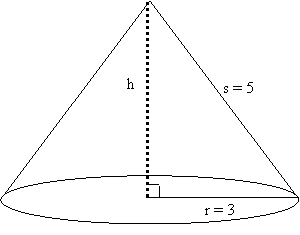
s = 5 cmThe information we have learned so far is summarized in the following diagram.To calculate the volume we need to find the values of r and h.
Since h, r, and s form a right triangle, we can use the Pythagorean Theorem to calculate the value of h
h2 + r2 = s 2
h2 + 32 = 52
h2 = 25 - 9
h2 = 16
h = 4 cm
The triangle involving h, r, and s always allows us to use the Pythagorean Theorem and s is always the hypotenuse.
We can now use r = 3 cm and h = 4 cm in the formula for volume:

 The radius of a cone is 5 inches and the volume is 100 p cubic inches. Find the slant height and surface area of this cone.
In a cone, the radius r is given as 2 and the slant height s as 6. Find its surface area and volume.
A cone has a slant height of 8 inches and a surface area of 48p square inches. What are the volume and radius of this cone?
and r = 4
and r = 4
and r = 4
A cone has a height of 6 and a volume of V = 8p. What are the radius and surface area of this cone?
- r = 2 and

- r = 2 and

- r = 4 and

This type of word problem involves the use of known formulas. Usually we used one of the formulas for either volume or surface area, depending on what information was given, to solve for the radius, height, or slant height of the cone. The Pythagorean Theorem must often be used to find a missing radius, height, or slant height. It is necessary to remember that the radius and height always are legs and the slant height always is the hypotenuse of the right triangle. In one case, when both the height and surface area were given, we had to solve a quadratic equation in order to determine the value of r. If that expression had not factored easily, we would have had to used the quadratic formula.
Once values of r, s, and h were known, the volume and surface area formulas were used. These problems require careful arithmetic since it is often difficult to determine whether or not our answers are reasonable.