Pyramids and Cones
By M Ransom
Introduction: We examine 3-dimensional objects known as pyramids and cones, defining them, and measuring their surface areas and volumes.
Definitions:
The Lesson:Pyramid: A 3-dimensional solid in which the base is a polygon and the sides are triangles which meet in one point called the vertex. We shall examine regular pyramids in which the base is a regular polygon and the sides are congruent triangles.
A Right Circular Cone: A 3-dimensional solid in which the base is a circle. The side of a cone is formed by straight lines which connect the circular base to a vertex. The height is the perpendicular distance from the vertex to the base and meets the base in the center of the circle.
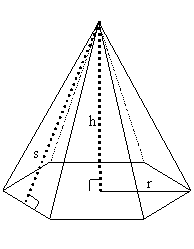
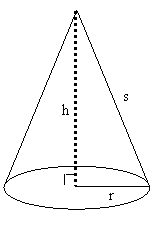
Let's Practice:The diagrams below show a pyramid and a cone. Both have a height of h and radius of r. In the pyramid at left, r is the radius of the regular hexagon that is the base of the pyramid. In the cone at right, r is the radius of the circular base. The slant height is s in both diagrams.
Pyramid:The perimeter of the base of the pyramid, which is a regular hexagon, is 6r since r is the same length as the side of a regular hexagon.
The area of the base of the pyramid is given by
.
The area of the sides (lateral area), which are congruent triangles, is given by
because in this case n = number of sides = 6, the base is equal to r, and the slant height of the triangles is s.
Notice that this can be rewritten as:
.
where P is the perimeter of the base.
Pyramid Summary:
- Surface area of a regular pyramid = area of base +
.
- Volume of a pyramid =

Cone Summary:
- The area of the base of the cone is
.
- The lateral area is given by
.
- The volume of a cone is given by
.

- In Egypt, the Great Pyramid of Giza is 145.75 m in height and has a square base of 229 m on a side. The triangular sides are congruent and form an angle of 51º with the square base. What are the surface area and the volume of this pyramid?
The base area is
2292 = 52441 m2.
The lateral area is
where s is the slant height of a triangular side.
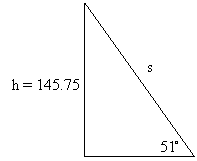
To calculate the slant height, we use the height and the slant height (as a hypotenuse of a right triangle) as in the diagram shown above. Using the trig function sine, we get
.
This gives us
.
The lateral area is
458s = 85875 m2.
The total surface area is
52441 + 85875 = 138,316 m2.
The volume is
area of base x height =
x 2292 x 145.75 =
x 7,643,275.75 m3 = 2,547,758.583 m3.
Despite the fact that well over 1,000,000 stone blocks weighing between 2 and 150 tons were manually installed, the exact measurements of the sides of the base and the angles of the triangles forming the sides are off by less than 0.1% from that of a perfectly regular pyramid.


- A cone has height 5 feet and the radius of the base is 2 feet. What are the surface area and the volume?
To find the volume we use
cubic feet.
To find the surface area we use
.
This means we must calculate the slant height s.
In order to do this, we note that the height is perpendicular to the base of the cone at the center. We use the height, radius, and slant height s to form a right triangle. A diagram is shown below.
We now use the Pythagorean Theorem.
s2 = 52 + 22 = 25 + 4 = 29
Now solve for s:
s =
This gives us a surface area of
ft2.



A regular pyramid has a hexagonal base of side 7 meters. The height is 5 meters. What are the surface area and the volume?
A right circular cone has height 60 centimeters and the base of the radius is 15 centimeters. What are the surface area and the volume?
Advertisement