Word Lesson: Volume and Surface Area of Prisms
By M Ransom
- know how to use basic formulas for volume (V) and surface area (SA) of a right prism:
- V = area of base x height
- SA = sum of both bases and the lateral area
- know how to find the area of a base:
- regular polygon: base area =
- regular hexagon: base area =


- know how to find the length of a side of a regular polygon using

- solve basic linear and quadratic equations.
Suppose the height of a right rectangular prism (rectangular solid) is 30 cm and the volume is 480 cm3. If the base is a square, find the surface area of this prism. A diagram is shown below.
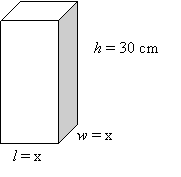
To get started, we sketch a diagram and label all of the given information to determine the appropriate formula(s) we will be able to use.Since we know the volume is 480 cm3, we will start with the formula for volume.
V = 480 cm3
V = lwhThe length l and width w are both the same in a square base allowing us to use the variable x for both l and w. Because h is given as 30 cm we can write:
V = (x)(x)(30)
V = 30x230x2 = 480
x2 = 16
x = 4 cmWe will now use x = 4 cm and h = 30 cm to calculate the area of all six rectangular sides of this prism. Remember that the 2 bases are equal as are the four sides making up the lateral area.There are two square bases. Since the length of a side x = 4, there is a total area of2x2 = 2(4)2 = 32 cm2
The four sides are rectangles with dimensions of width 4 cm and height 30 cm for a total area of4(4)(30) = 480 cm2
The total surface area is32 cm2 + 480 cm2 = 512 cm2
 A right prism with regular hexagonal bases has a height of 20 inches and a radius of 5 inches. What are the surface area and volume?
A right prism has a regular pentagon of radius 7 for a base and a height of 10. What are the volume and surface area of this prism?
A right prism has a regular hexagon of radius 12 as a base. If the height is 10, what are the volume and surface area?
- V =
and SA =
- V =
and SA =
- V =
and SA =



A right prism has a height of 14 and a regular octagonal base of radius 9. What are the volume and surface area of this prism?
- V = 357 and S = 822.4
- V = 3207.4 and S = 1229.6
- V = 275.7 and S = 1534.2
This type of problem involves the use of several formulas. If the prism is neither rectangular nor hexagonal, we must use formulas involving sine and cosine to get the area of the base and the length of one side of the base. If rectangular, we can use length x width for areas of rectangular sides and bases. If hexagonal, we have that the radius and length of a side of the base are the same and the area of the base is given by  .
.
In any case, the base area is used to get the volume when we multiply it by the prism's height. The side of the base is used to get the perimeter which is then used to get lateral area, LA = h x P, where h is the height of the prism.