Cylinders and Prisms
By M Ransom
Introduction: We examine cylinders and prisms, defining them, and measuring their surface areas and volumes.
The Lesson:
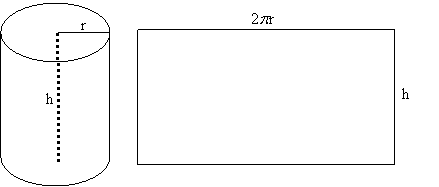
We may think of a cylinder as a tin can, with two bases that are circles. The surface wrapping around the circles can be “unwrapped” and shown as a rectangle. A diagram below shows a cylinder on the left. The rectangle at right is the side surface, unwrapped from the cylinder. We know that its length is the circumference of the circular base which is
.
The surface area is the sum of the areas of the two circles that are the bases and the area of the rectangle. Since the area of a circle is
and the area of a rectangle is lw, we can make a formula for the surface area of a cylinder:
.
The volume of a cylinder is found using the concept of base x height. The area of the base is
. The volume of the cylinder is
.
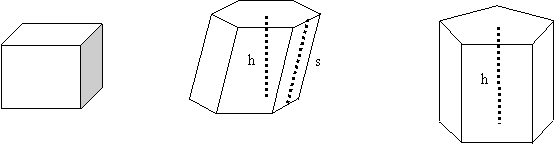
A prism is a (3-dimensional) polyhedron with bases that are parallel, congruent polygons. The sides are parallelograms. We show three examples below. The important features are the areas of the bases and the height, which is the perpendicular distance between the bases.
At the left is a rectangular solid. The middle diagram is of a prism with bases that are hexagons. Notice that the slant height, s, is different than the height, h, since the prism is tilted. The prism at right has bases that are pentagons and is not tilted. We shall concentrate on prisms such as this which are called right prisms.
Volume and surface area can be found as follows:
- Volume = base (area) x height
- Surface Area = sum of areas of both bases and all sides
The area of the bases can be found if we know the dimensions and properties of the polygons which form the bases. The area of all the sides (called the lateral area) can be found if we can measure the base and height (called the slant height and labeled “s”) of each of the parallelograms which form the sides of the prism. Adding the areas of the parallelograms which form the sides can be summarized by multiplying the slant height and the perimeter of a base. We have:
- Surface Area = sum of areas of both bases and s x P where s is the slant height and P is the perimeter of a base.
If the bases are perpendicular to the parallelograms forming the sides (as in a right prism), the slant height s = h.
Let's Practice: We label the three prisms below A, B, and C. A is a rectangular solid. B is a non-right prism. C is a right prism.
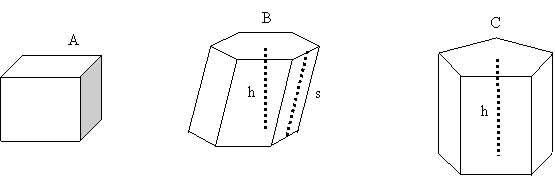
- Suppose prism A has dimensions 5 x 4 x 7 feet. What are the surface area and volume?
We solve this using standard formulas for a rectangular solid.
The volume is 5 x 4 x 7 = 140 cubic feet. Two sides are 5 x 4, two are 4 x 7 and two are 5 x 7. The areas of these sides are 20, 28, and 35.
Thus the total surface area is twice the sum of these or 166 square feet.
- Suppose prism B has bases which are regular hexagons of side 2 meters, a height of 3 meters, and a slant height of 3.4 meters. What are the surface area and the volume?
The lateral area equals
s x P = 3.4 x 12 = 40.8 m2.
The area of a regular hexagon (base) is
m2.
This gives a total surface area of two bases plus the lateral area which equals
m2.
We now know the volume = area of base x height equals
m3.

- Suppose right prism C has bases which are regular pentagons of radius 25 centimeters. The height is 40 centimeters. What are the surface area and the volume?
For the area of a base we use
.
This gives us area of base as
cm2.
We calculate volume = area of base x height as
1486 x 40 = 59440 cm3 = 0.05944 m3.
The lateral area is s x P where P is the perimeter of the base of the regular pentagon with radius 25 and s = h is the slant height.
A side can be found from
.
This gives us the length of a side of the base as
cm.
The lateral area equals
s x P = 40 x 5(29.39) = 5878 cm2.
The total surface area is two bases plus the lateral area or
8850 cm2 = 0.885 m2.


- A tin can has a radius of 2 inches and a height of 3 inches. What are the surface area and volumes?
The volume is
in3.
The surface area is
in2.


A right octagonal (8 sided base) prism has a height of 9 feet. If the bases are regular octagons with radius 4 feet, what are the surface area and volume?
A cylinder has a radius of 6 centimeters and a height of 10 centimeters. What are the surface area and the volume?
Advertisement