Solving Rational Inequalities
By S Taylor
A rational expression looks like a fraction and has a variable in the denominator. A rational inequality just means we now have a rational expression combined with a
 ,
,
 ,
,
 ,
,

or sign. Below are some examples of what a rational inequality might look like.



Solving rational inequalities requires the same initial step as solving quadratic equations; we MUST get all terms on the left side of the inequality sign and have zero on the right side of the inequality sign. Once all terms are on the left side of the inequality, we have to make sure we only have a single rational expression.
By having a rational expression compared to zero (with a
 ,
,
 ,
,
 ,
or
,
or

sign), we will only need to find where the expression is equal to zero (set the top = 0) or where the expression is undefined (set the bottom = 0). Since the expression can change signs (from positive to negative or from negative to positive) at these points we can call them changing points.
When we place the changing points on a number line, we will obtain intervals along the number line. We will substitute a test value from each interval into the inequality to see if the inequality is true or false. If it is true, then all values in the interval will make the inequality true. If it is false, then all values in the interval will make the inequality false.
Summary of steps:
- Write the inequality so that there is a single rational expression on the left side of the inequality and zero on the right side of the inequality.
- Determine the changing points by setting the numerator equal to zero and setting the denominator equal to zero.
- Use the changing points to separate the number line into intervals.
- Select test values in each interval and substitute those values into the inequality.
- If the test value makes the inequality true, then the entire interval is a solution to the inequality.
- If the test value makes the inequality false, then the entire interval is not a solution to the inequality.
- Express your answer in interval notation.

Steps:
- Is there a single rational expression on the left and zero on the right?
yes
- Determine the changing points.
→
and
→


- Use the changing points to break up the number line into intervals.
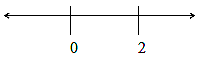
- Select three test values and substitute each one into the inequality.
A number less than 0: x = -1
(false)
A number between 0 and 2: x =1
(true)
A number larger than 2: x = 3
(false)
What interval would make the inequality true?
The answer in interval notation is
 .
Note the use of a left bracket with 0 to indicate that 0 is included in the interval because of the
.
Note the use of a left bracket with 0 to indicate that 0 is included in the interval because of the

sign in the inequality. Also note that a right parentheses is used with 2 to indicate that 2 is NOT included in the answer. Although the inequality is
 ,
we cannot include 2 because it will make the inequality undefined.
,
we cannot include 2 because it will make the inequality undefined.

The answer in interval notation is
 .
Anytime
.
Anytime

or

are used in interval notation, parentheses are to be used. Since the original inequality is
 ,
the end values are not included which means parentheses are to be used.
,
the end values are not included which means parentheses are to be used.

Steps:
- Is there a single rational expression on the left and zero on the right?
no
- Rewrite the inequality.



Now you can continue your solution by first determining the changing points and test three values.
The solution in interval notation is
 .
Because the inequality is
.
Because the inequality is
 ,
the endpoints are not included in the answer.
,
the endpoints are not included in the answer.

The solution in interval notation is  . Because the inequality is
  we should include the endpoints of the intervals, but
  and
and  make the inequality undefined so we cannot include them as part of the solution.
Advertisement