Operation with Rational Expressions
By S Taylor
Since rational expressions are just fractions with variables in the denominator, we are going to start by reviewing operations with fractions that do not contain variables. Then we will move on to performing the same operations on rational expressions.
Let’s start with multiplication. Remember that to multiply two fractions together, you simply multiply the numerators together and multiply the denominators together. You should also remember that if you can simplify each fraction (cross-cancel) before multiplying, you should

When dividing fractions, you leave the first fraction as it is, you find the reciprocal, or flip, the second fraction and change the division problem to a multiplication problem.

Addition and subtraction of fractions involves having a common denominator. If the fractions already have the same denominator, you just add the numerators and keep the denominator the same. If the fractions do not have the same denominator, you have to find the least common denominator and create equivalent fractions before adding or subtracting.


Now let’s see how all of this relates to operations with rational functions.
Multiplication
When working with multiplication problems, you should begin by factoring any terms that can be factored. For help with factoring, click here. Once you have the problem in factored form, divide out any common factors and simplify the expression. If you need help with simplifying rational expressions, click here.

- Check to see if anything can be factored.
- Divide out any common factors.
- Simplify.
No factoring is required.
=
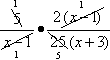

- Check to see if anything can be factored.
- Divide out any common factors.
- Simplify.

=
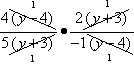

Division
Division problems will follow the same process as multiplication only with an additional step at the beginning. The first step you have to do is to find the reciprocal (or flip) the second fraction and change the problem to a multiplication problem. Once it is in the form of a multiplication problem, follow the same steps as in the previous examples.

- Invert the second fraction and change the problem to multiplication.
- Check to see if anything can be factored.
- Divide out any common factors.
- Simplify.
=

No factoring is required.
=
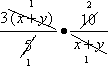

- Invert the second fraction and change the problem to multiplication.
=


Addition and Subtraction
When working with addition and subtraction, the denominators must be the same. If they are, proceed by adding the numerators. If they are not, find the least common denominator, create equivalent fractions, and then add the numerators.

- Are the denominators the same?
- Add the numerators and simplify.
yes


- Are the denominators the same?
- What is the least common denominator?
- Create equivalent fractions.
- Add the numerators and simplify.
no

=





Advertisement