Roots of Polynomials
By M Ransom
- Polynomials are expressions involving x raised to a whole number power (exponent).
Some examples are:



Roots of a polynomial are values of x which make the polynomial equal zero. For the examples of polynomials above, that means solving the following equations:



- Zeros of a polynomial: This is another term for “roots.”
- If the roots are real, they are the x-intercepts on the graph of the polynomial.
- If no roots are real (all roots are complex numbers of the form a + bi) then the polynomial graph does not intersect or cross the x-axis.
- The roots relate directly to the factors. For example, if 3, 4 and 7 are the roots, then the factors of the polynomial are (x - 3), (x - 4), and (x - 7).
If the roots are not easy to find, locate the roots by using the TI-83 calculator under
and the “2: zero” function.


Let's Practice:
We will now examine five polynomial functions and their roots. In each case, the accompanying graph is shown under the discussion.
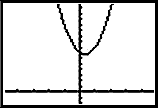
is a parabola and its graph opens upward from the vertex
. Note that since the graph does not cross the x-axis the solutions to
are not real numbers.
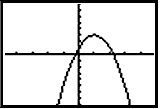
is a parabola and its graph opens downward from the vertex (1, 3). This graph was created by using the WINDOW (-5, 5) X (-8, 8). There are two x-intercepts and therefore two solutions to the equation
. Solutions can be found using
and the “2: zero” function. The x-intercepts are -0.22 and 2.22.
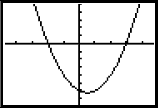
. This polynomial factors as
The factors (x + 2) and (x- 3) make it clear that x = -2 and x = 3 are the roots or zeros of the parabola.
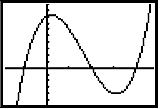
. This polynomial factors, but the factoring is not obvious. By examining the graph, we can see that the roots or zeros appear to be integers. That is a clue that this polynomial factors nicely. Using
and the "2: zero" function, we can verify that these roots are: -1, 2, and 4. This means that









Let  . Find the roots of P(x). What are the factors of P(x)?
Let  . Find the roots of P(x). What are the factors of P(x)?
Let

Find the roots of P(x). What are the factors of P(x)?
Let  . Find the roots of P(x). What are the factors of P(x)?
Let
 . Find the roots of P(x). What are the factors of P(x)?
Advertisement