Intercepts of Lines
By S Taylor
What are intercepts and how do you find them?
Intercepts are where a graph crosses either the x-axis or the y-axis. Not all functions will have intercepts, but when you are working with the graph of a linear function, it will have both an x-intercept and a y-intercept. An x-intercept is where the graph crosses the x-axis and a y-intercept is where it crosses the y-axis.
Let’s think about a line that crosses the x-axis. If it is crossing the x-axis, then the y-value of that point will be zero. Similarly, when dealing with the y-intercept, this is where the x-value is zero. We will use this information in finding x-and y-intercepts.
Let's Practice:The general rules are:
- To find an x-intercept, let the value of y in the equation be equal to zero.
Your x-intercept will be written as a point.
- To find a y-intercept, let the value of x in the equation be equal to zero.
Your y-intercept will be written as a point.
- Find the x- and y-intercepts for
 .
.
The y-intercept is found by letting x = 0.
We write the y-intercept as
,
The x-intercept is found by letting y = 0.
We write the x-intercept as
.


You may have noticed something interesting about the y-intercept in the previous example. The y-intercept was the number by itself in the equation of the line. The equation in Example 1 is called the slope-intercept form of a line and in general is written as
 . In this equation, the slope of the line is m and the y-intercept is b. You can learn more about finding the slope of a line by clicking here.
This slope-intercept form of a line makes is easy to find the y-intercept.
More Practice:
- Find the x-and y-intercepts for

Since this equation is in slope-intercept form, we can find the y-intercept by looking at the equation. The y-intercept is 4 and is written as
.
To find the x-intercept, let y = 0 in the equation.
The x-intercept is written as
.

- Find the x-and y-intercepts for
 .
.
This equation is not in slope-intercept form, so we go back to our strategy of substituting x = 0 to find the y-intercept.
The y-intercept is
. To find the x-intercept, let y = 0.
The x-intercept is
.


There are two special types of lines that need to be considered when talking about intercepts. These are horizontal lines and vertical lines.
Final Practice:
- A horizontal line is in the form y = k; that is,
no matter what the x-value is, the y-value is always a constant value.- A vertical line is in the form x = h; that is,
no matter what the y-value is, the x-value is always a constant value.
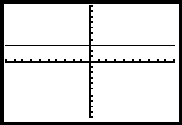
- Consider the graph of y = 3.
The horizontal line shown in this graph will never cross the x-axis. A horizontal line (other than y = 0) will not have an x-intercept. The line y = 0 is another special case since y = 0 is the equation of the x-axis.
The y-intercept will always be the number in the equation. So in this case,
.
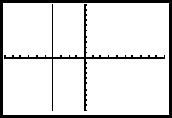
- Consider the graph of x = -4.
The vertical line shown in this graph will cross the x-axis at the number given in the equation. For this equation, the x-intercept is
.
Notice this line will never cross the y-axis. A vertical line (other than x = 0) will not have a y-intercept. The line x = 0 is another special case since x = 0 is the equation of the y-axis.
Now that you have these tools to find the intercepts of a line, what does this information do for you? What good are intercepts other than just knowing points on a graph?
The x-and y-intercepts play a key role in graphing linear functions. To learn more about graphing lines, click here.
Find the x- and y-intercepts for the line y = -6x - 18
Find the x- and y-intercepts for the line 8 - 4/3y = 0
Find the x- and y-intercepts for the line -3x + 12 = 0
Find the x- and y-intercepts for the line 7x + 4y = 56.
Advertisement