Basic Quadratic Terminology
By S Taylor
A quadratic expression is one where the largest power for the variable is 2. Some examples of quadratic expression are shown below.


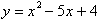
A quadratic equation is an equation where the largest power for the variable is 2. Remember that an equation has an equal sign in it. Some examples of quadratic equations are:



Quadratic equations can be solved in order to find the roots of the equation. Roots are also called zeros or x–intercepts if the graph crosses the x–axis. The roots of a quadratic equation simply tell what values of x will make the equation true.
A quadratic function is a function where the largest power for the variable is 2. A function usually takes the form of y = or f(x) =.
So what are the key differences between an expression, an equation, and a function?
- A quadratic expression is usually just something that can be simplified or factored. You cannot solve an expression for a variable. You can only manipulate the terms you are given.
- A quadratic equation is given to you so that you can solve it for the variable.
- A quadratic function is given to you so that you can graph it.
Directions and/or Common Information:
The graph of a quadratic function is called a parabola. A parabola can either have a “u” shape or an “n” shape depending on the number in front of the
 term. If the number in front of x2 is positive, the parabola will open up; if the number in front of x2 is negative, the parabola will open down.
 open?
open? open?
open?
Regardless of whether the parabola opens up or down, all parabolas will have a vertex. If the parabola opens up, the vertex is the minimum point or the place where the graph bottoms out. If the parabola opens down, the vertex is the maximum point or the place where the graph reaches its peak.
Quadratic functions can be written in one of two ways, depending on what you are trying to do with the equation.
- The standard form of a quadratic function is
 . Notice that “a” cannot be zero or else the equation is not considered a quadratic. The standard form is most often used when solving a quadratic equation. This form should be used when factoring or using the quadratic formula.
 - The vertex form of a quadratic function is
 . This shows the vertex is at the point (h, k). So when a quadratic is in this form, finding the vertex is very easy. If you are looking for the vertex and your equation is not in this form, you can use the method of completing the square to change the equation into the vertex form.
The two key pieces for graphing a quadratic equation are having the roots and the vertex. Along with the vertex and the roots, you can plot several other points to get a complete graph of a quadratic. If the roots are imaginary, plotting additional points is required to get an accurate graph.
Directions and/or Common Information:
For each question, determine whether the information given represents a quadratic expression, a quadratic equation, or a quadratic function.#1: y = -3x2 - 4
#2: -3x2 + x - 1 = 0
#3: -3x2 + 4x
#4: 6x2 = 5x
#5: 3x2 = 5x - 7x2 + 1
#6: y = ½(x-2)2 - 4
Advertisement