Translations of Parabolas
By S Taylor
The graph of a quadratic function is a shape called a parabola. The most basic parabola is obtained from the function  . The graph of
  is shown below.
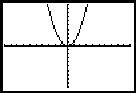
The vertex of the graph of  is at (0, 0). If the vertex is at some other point on the graph, then a translation or a transformation of the parabola has occurred.
When a quadratic function is given in vertex form,  , it is easy to see the new location of the vertex is at (h, k). To learn more about the vertex form of a quadratic function, click here to reach an introductory lesson on quadratics.
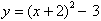
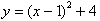
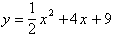
When a quadratic function is given in standard form,  ,
the vertex is not as easy to locate. You must either use a formula for finding the vertex, or use the method of completing the square to put the function in vertex form.
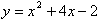
,
the vertex is not as easy to locate. You must either use a formula for finding the vertex, or use the method of completing the square to put the function in vertex form.
In each of the previous examples, the coefficient in front of
 has been 1. But both the vertex form,
  , and the standard form,
  , allow for the possibility of a different coefficient. Let’s explore different values in front of and see what happens to the graph.
Below is the basic graph of  and several other graphs where the coefficient in front of has been changed. Examine each graph and see if you can tell what is happening.
 |  |  |
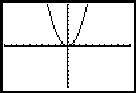 | 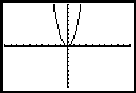 | 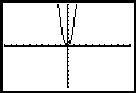 |
A coefficient larger than 1 will make the graph more narrow. Sometimes this is explained as moving away from the x-axis. Now look at some other graphs.
 |  |  |
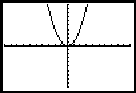 | 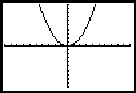 | 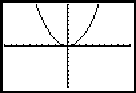 |
When the coefficient is between 0 and 1, the graph becomes wider. Another way to say this is that it moves toward the x-axis.
We now need to look at what happens if the coefficient is a negative number.
 |  |
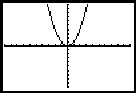 | 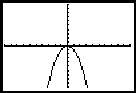 |
Whenever the coefficient is a negative number, the parabola will be reflected, or flipped over, the x–axis.
If the coefficient is negative and has a number, then you must flip the parabola and the make it more narrow or wider.


Note that in this example you will see combinations of reflections, wider/more narrow, and change in vertex all in the same problem.
Advertisement