Word Lesson: Quadratic Regression
By D Saye
- know how to enter data into your graphing calculator for completing modeling problems
- know how to solve quadratic equations
- know how to calculate a quadratic equation that best fits a set of given data
- write and solve an equation for the problem
Year | AIDS Cases |
1999 | 41,356 |
2000 | 41,267 |
2001 | 40,833 |
2002 | 41,289 |
2003 | 43,171 |
Our approach will be to:
- plot the data, letting x = 0 correspond to the year 1998,
- find a quadratic function that models the data,
- plot the function on the graph with the data and determine how well the graph fits the data,
- use the model to predict the cumulative number of AIDS cases for the year 2006.
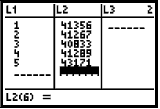
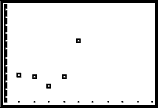
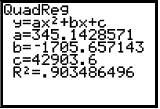
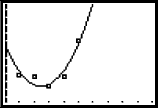
First we will plot the data using a TI-83 graphing calculator. Since 1998 corresponds to x = 0, the year 1999 will represent x = 1, 2000 will represent x = 2, etc. Once the data is entered, your screen should look like the following:After entering the data into the calculator, graph the data. Your screen should look like the following:Next we want to find a quadratic equation that best fits the data we have plotted. According to the calculator, the equation is the following:The graph of the function is the following:Based on the graph and the equation information listed above, it is clear that a quadratic is not a perfect function for representing this data. We know that R= 0.903486496, so
. Remember that a graph is a perfect fit for data when
. However, based on the graph, our function is a fair fit for the given data. It would be better to have more data so that we could determine a graph having a better fit.
Using our model
to predict the cumulative number of AIDS cases for the year 2006, we find that we expect that there will be approximately 51,347 cumulative AIDS cases diagnosed in the year 2006.
On Tuesday, May 10, 2005, 17 year-old Adi Alifuddin Hussin won the boys’ shot-putt gold medal for the fourth consecutive year. His winning throw was 16.43 meters. A shot-putter throws a ball at an inclination of 45° to the horizontal. The following data represent approximate heights for a ball thrown by a shot-putter as it travels a distance of x meters horizontally.
Distance (m) | Height (m) |
7 | 8 |
20 | 15 |
33 | 24 |
47 | 26 |
60 | 24 |
67 | 21 |
Time (Hours) | Concentration (mg/l) |
0 | 0 |
0.5 | 78.1 |
1 | 99.8 |
1.5 | 84.4 |
2 | 50.1 |
2.5 | 15.6 |
Time (seconds) | Distance (feet) |
0 | 1821 |
2 | 1757 |
4 | 1565 |
6 | 1245 |
8 | 797 |
10 | 221 |
- 354 feet
- 57 feet
- 221 feet
- 3585 feet
Year | Number (thousands) |
1994 | 50 |
1996 | 56 |
1998 | 65 |
2000 | 75 |
2002 | 94 |
2004 | 110 |
- 130,000 feet
- 132,000 feet
- 160,000 feet
- 157,000 feet