Introductory Calculus: Anti-derivatives, Integrals, Area Under a Curve
By M Ransom
 Given a function
  , an anti-derivative is another function which has
  as its derivative.
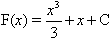
For example,is an anti-derivative of
.
In fact, the 7 is not unique. Any function of the general formis an anti-derivative of
.
In this lesson we will find anti-derivatives and in some cases find the exact value of. We will also use anti-derivatives to calculate the areas of regions bounded by the graphs of given functions.
For x to any power we have the following rule:Let's look at some examples:
- Find an anti-derivative of
 .
.


- Find the area below the graph of
 , bounded below by the x–axis, on the right by
  , and on the left by
  .
.
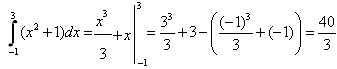
We start by finding an anti-derivative, then substitute 3 and -1 for, evaluate, and subtract their values.
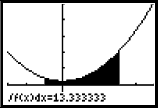
We know that our general anti-derivative is of the formSubstituting in 3 and -1 for x and subtracting gives us [notice that the "C's" cancel]The area under the curve is 40/3 or 13.3 as shown on the diagram below.Mathematically we write:


- Find the anti-derivative of
 if we know that F(x) = 5 when
  .
.
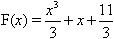
We know that our general anti-derivative is of the formTo find our specific value for C, we set x = 1 and F(x) equal to 5 and solve for C:Therefore the anti-derivative we want is