Introductory Calculus: Exponentials and Logarithms
By M Ransom

 Properties of Exponents: To review some of the fundamental properties of exponents, we will look at several examples.
 If a > 0, b > 0, and x and y are any real numbers, then:
- ax ● ay = ax+y










 Properties of Logarithms: To review some of the fundamental properties of logarithms, we will look at several examples.
 If x and y are both positive numbers, then:
- Meaning of Log: If
.
If

Notice: the log is the exponent.
- ln(x) means loge(x) where
.








 Putting It All Together:
Solve for x if.
By direction inspection we can see that x must equal 4.Solve for x if.
In this case, direct inspection fails us since 4 is too big - giving us 16 - and 3 is too small - only giving us 8.To get an exact answer, we would use logarithms:Step 1:Step 2:Step 3:
Let's Practice. In the following five equations, solve for x (accurate to 3 decimal places).






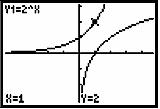
 Graphs: A graph of both
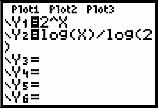
  is shown below right. Notice that in order to graph
  , it is necessary to rewrite as
  since there is no log base 2 button on the calculator. Also, notice that the point (1, 2) is on
  . Since
  is its inverse, the point (2, 1) will be on that graph.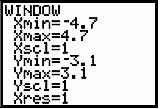
 Derivatives: Given below are ten examples of taking derivatives of exponential functions and logarithms.

- Show that
has a relative minimum at
.
We know from example #3 above that.
If we set this equal to 0, we get.
We note that for, this derivative is negative, and for
, the derivative is positive.
This change in sign from negative to positive is the proof that we need to know thathas a minimum value when
.








Let's Practice.
Using example #8 above as a guide, show that  has a relative minimum at x = 1. Be careful to check values of
  very close to 1 for the sign of
  .
.
has a relative minimum at x = 1. Be careful to check values of very close to 1 for the sign of .Using example #7 above as a guide, find any max or min of  .
.