Introductory Calculus: The Derivative
By M Ransom
 Slope of a secant line
  Slope of a tangent line:
- If
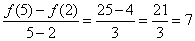
 , we can find the slope of a secant line between the points where x = 2 and x = 5 very easily:
This is the average rate of change ofover the interval
and is the slope of the secant line connecting two points (2, 4) and (5, 25).
- Suppose we want the exact (or instantaneous) rate of change at the one point (2, 4). We cannot calculate this slope using standard methods because we need two points to calculate slope. But suppose that when
 and a is “very close” to 2, we calculate the slope of a secant line. We get:
To calculate the slope at exactly, imagine “a” getting “closer” to the number 2. We have:
This means that the instantaneous rate of change ofat
is 4.
We call this the derivative ofat
and we write this as
(read: “f prime of 2 equals 4”).
To calculate the derivative ofat any point x (not just
), we use the same approach as in the work done above. We have:
Therefore we say that the derivative ofis
.



.
 The derivative of
  :
: - We can use this method to calculate the derivative of other functions, for example
 .
.
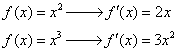
This process can become difficult since we are relying upon “nice” factorization. Notice what we have thus far:A pattern is developing here. We would next have.
We generalize this into what is called the power rule.

Let's Practice:
- Find
 .
.
We have by the power rule.
- Find
 .
.
We have by the power rule.
- Find
 .
.
We rewriteas
.
Therefore,.
- Find
 .
.
We havefor any constant such as 4.
- Find
 .
.
We have.
- What is an equation of the line tangent to
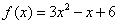 at the point where
  ?
?
We get the slope for this equation from the derivative at.
We get the “y-value” (the function value) forfrom
.
Therefore, our equation is.

Find  when
when  .
.
Find y' when  .
.
Find  when
when  .
.
Write the equation of the line tangent to  at the point where
  .
.
Write the equation of the line tangent to  at the point where
  .
.
Write the equation of the line tangent to  at the point where
  .
.