Introductory Calculus: Limit of a Function and Continuity
By M Ransom
 The limit of a function from left or right or both:
- If
 , we call the limit of this function as x approaches 1 from the left as
Similarly, we call the limit as x approaches 1 from the right equal to 2.
What is mysterious about this concept of limit?The function obviously has a value of 2 when x = 1.
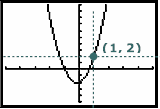
We say thatThis is a simple thing to analyze because this function is continuous (the graph is “connected”) and we can clearly see that the function value at x = 1 is 2. See the graph below.




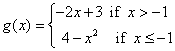
- Suppose that
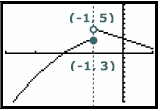
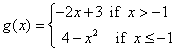
What is the limit as x approaches –1 from the left/right?
We will get two different values for this limit because there are two different expressions for.
If x approaches –1 from the left [for], we use the formula
which gives us
If x approaches –1 from the right [for], we use the formula
which gives us
In this case, we say thatSince these limits are different, we say that the ONE limit as x approaches –1 does not exist. In order for this limit to exist, both the left hand and right hand limits would have to be the same, and the graph would have to “connect” from the left and right sides.These limits from the left and right have different values. Looking at a graph from a calculator screen, we can see that the left hand graph and the right hand graph do not meet in one point, but the limits from the left and right sides can be seen on the graph as the y values of this function for each piecewise-defined part of the graph. Notice the “open” circle and "closed" circle on the graph.
Notice that the value of the functionat the point –1 is
because only
defines this function for the value x = –1. This is an important fact as we examine the continuity of a function. We will compare this value, if it exists, to the limit value.





 Continuity of a function at a point x = a:
- Using our function
we apply the definition of continuity at the point x = –1.
Condition (i) is OK because
meaning that
exists.
Condition (ii) is not OK because
meaning
does not exist.
We can STOP here because as soon as one of these three conditions goes wrong, we know the function is NOT continuous at the given value of x.Find the following limits if they exist.


Use the following two functions to answer the next set of questions.
and
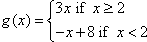


Discuss the continuity of f(x) and g(x) at x = 2.
Test your understanding about limits by answering the following two questions about two new functions: h(x) and r(x).

Graph and discuss continuity at x = 3.
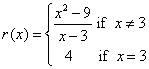
Graph and discuss continuity at x = 3.