Word Lesson: Vectors Right Triangles - Components and Resultants
By M Ransom
- Know the relationships among rectangular vector coordinates, polar coordinates, magnitude, and direction
- Apply vector diagrams to find components from given information
- Find an angle given a right triangle ratio of sides
- Use the Pythagorean Theorem
 .
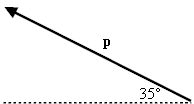
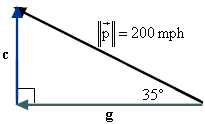
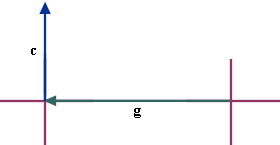
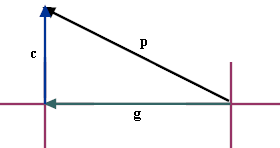
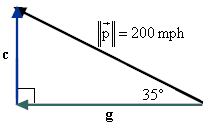
.First we make a diagram. In this case, the plane’s path makes a 35° angle with the ground. We call this vector p.The hypotenuse of the triangle is given a length of 200 mph which is the magnitude of the vector p describing the plane’s path. The vector representing climbing vertically away from the ground is c and the vector representing the ground speed is g. The right angle is formed between vectors c and g which are components of p.
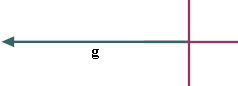
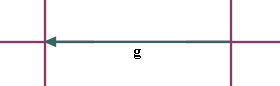
When adding vectors, we start by placing the head of the first vector (g) at the original of a co-ordinate system. At its tail we place the origin of a second co-ordinate system and the head of the second vector (c). The resultant (p) is the vector that begins at the head of vector 1 (g) and ends at the tail of vector 2 (c) as shown in the diagram to the right.


Directions and/or Common Information:
No audio files were recorded for this set of examples.A force of 100 pounds is required to pull a 400 pound block up a ramp at a constant speed. What angle does the ramp make with respect to the ground?
Directions and/or Common Information:
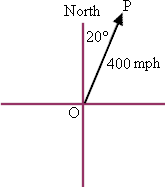
No audio files were recorded for this set of examples.An airplane is flying North at 500 mph when a wind of 20 mph comes up out of the East. What is the new speed and direction of the plane if no correction is made for the wind?
- 500.4 mph and bearing 357.71°
- 500.4 mph and bearing 359.96°
- 499.6 mph and bearing 357.71°
An object is pulled up a ramp at an angle of 17° with the ground level. If the force required to move this object up the incline at a constant speed is 200 pounds, how much does the object weigh?
- 654 pounds
- 209 pounds
- -208 pounds
- 684 pounds
As you can see, this type of problem requires a diagram of a carefully labeled right triangle. The measures of the magnitudes of any given vectors and their components as well as any known angles should be labeled. Trigonometric ratios often help us set up an equation which can then be solved for the requested missing information.. If the two legs of the triangle are a part of the problem, it is a tangent ratio. If the hypotenuse is part of the problem, it is either a sine or cosine ratio.