Origins of the Names of Trigonometric Functions
By M Ransom, K Mathis
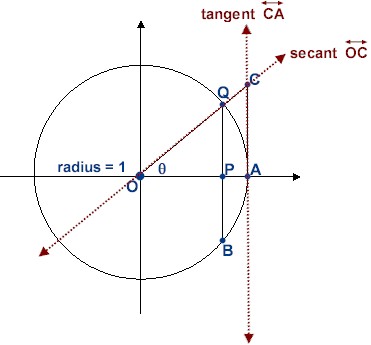
Introduction: Originally, all six trigonometric values were defined by the lengths of the sides of the triangles, the chord, and the secant as shown in the following unit circle diagram. It wasn’t until the 16th century that Georg Joachim Rhaeticus, a Teutonic astronomer, defined the trigonometric functions as the ratios of the sides of a right triangle as we use them today.
The Lesson:
In the diagram below, using a standard rectangular coordinate system, you see a unit circle of radius 1 with its center at the origin (0, 0).
O is the origin
Q and B are points on the circle
O, Q, C and Q, P, B are co-linear
CA is tangent to the circle at A
Since the length of the radius OQ equals 1,
basic right triangle trigonometry tells us thatQP = sin(q)
OP = cos(q)
CA = tan(q)
OC = sec(q)
The terms sine, secant, and tangent were originally chosen by Arab mathematicians because of the position of the segments of these lengths in this unit circle.
Sine: The word “sine” actually comes from a mistranslation of a word which is the origin of our word “chord.” It can be seen that QB is a chord and is twice the length of the sine of q.
This is because in triangle OPQ:
sin(q)
.
Tangent: The ratio
defines tan(q).
Note that the line CA,
, is tangent to the circle.
Secant: The ratio
defines sec(q).
Note that the line OC,
, is a secant of the circle.
The terms cosine, cotangent and cosecant can be understood by knowing that the prefix “co” refers to “complement.”
This is because the values of these co-functions: cos(x), cot(x), and csc(x) are equal respectively to the values of: sin(90º - x), tan(90º - x), and sec(90º - x) for their complementary angles.


Directions and/or Common Information:
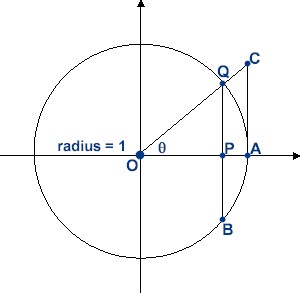
In a unit circle, the coordinates of Q are given as (0.9063, 0.4226).
What is the sine of q?
In a unit circle, the coordinates of Q are given as (0.9063, 0.4226).
find the cosine of (90º - q).
In a unit circle, the coordinates of Q are given as (0.9063, 0.4226).
What is the cosine of q?
In a unit circle, the coordinates of Q are given as (0.9063, 0.4226).
How long is the line segment AC?
Use the unit circle to show that sec(q)2 = 1 + tan(q)2.
Advertisement