Word Lesson: Angles of Elevation and Depression
By M Ransom
- use basic right triangle trigonometry
- solve equations which involve one fractional term is also important to know.
- find an angle given a right triangle ratio of sides.
- the fact that corresponding angles formed by parallel lines have the same measure.
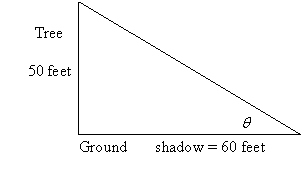
First we should make a diagram to organize our information. Look for these diagrams to involve a right triangle. In this case, the tree makes a angle 90º with the ground. A diagram of this right triangle is shown below.In the diagram, known distances are labeled. These are the 50 and 60 foot legs of the right triangle corresponding to the height of the tree and the length of the shadow.The variable q is chosen to represent the unknown measurement, the object of the question.
To relate the known distances and the variable, an equation is written. In this case the equation involves the lengths of the sides which are opposite and adjacent to the angle q. Using the ratio of opposite to adjacent sides, we have
.
We use inverse tangent of
or
which is the angle of elevation.
 John wants to measure the height of a tree. He walks exactly 100 feet from the base of the tree and looks up. The angle from the ground to the top of the tree is 33º . How tall is the tree?
 A building is 50 feet high. At a distance away from the building, an observer notices that the angle of elevation to the top of the building is 41º. How far is the observer from the base of the building?
Now try these next two problems based on the examples and information that you have learned so far.
An airplane is flying at a height of 2 miles above the ground. The distance along the ground from the airplane to the airport is 5 miles. What is the angle of depression from the airplane to the airport?
- 65.2º
- 23.58º
- 66.42º
- 21.8º
- 0.38º
A bird sits on top of a lamppost. The angle of depression from the bird to the feet of an observer standing away from the lamppost is  . The distance from the bird to the observer is 25 meters. How tall is the lamppost?
- 14.34 meters
- 20.48 meters
- 17.5 meters
- -10.7 meters