Word Leson: Area and Perimeter of Triangles
By M Ransom
- Know how to use basic formulas for area and perimeter of a triangle. The area is A = ½bh where b is the length of the base of the triangle and h is the altitude to that base. The perimeter is found by adding the lengths of the three sides.
- Solve basic linear and quadratic equations.
- Use the Pythagorean Theorem in finding the length, width, and hypotenuse of a right triangle.
- Know the formulas for the height and area of an equilateral triangle where s is the length of one side:
 and
and  .
. - Know basic trig functions and how to use them in a right triangle.
A typical problem involving the area and perimeter of a triangle gives us the area, perimeter and/or side lengths and altitude (we shall use the variable “h” for height) of the triangle. We may also be given a relationship between the area and perimeter or between the sides and altitude of the triangle. We may know one or more of the angles of the triangle. We need to calculate some of these quantities given information about the others. Two examples of this type of problem follow.
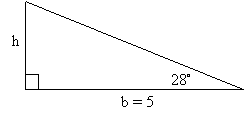
Suppose in a right triangle one of the legs is of length 5 and the angle formed by the hypotenuse and this leg is 28°. What are the area and perimeter of this triangle? A diagram is shown below.A right triangle is a special case of this type of problem since the legs are perpendicular. One leg is the base and the other is the height or altitude of the triangle. In order to find h in the diagram above we use
h » 2.6585We can now find the area fromA = (1/2)bh = (1/2)(5)(2.6585) = 6.64625To find the perimeter, we need the hypotenuse so we can add all three sides. We find the hypotenuse using the Pythagorean Theorem:We add the lengths of the three sides and getperimeter = 13.3213


Suppose a triangle with area 28 has a base of 7x and a height of 4x as shown in the diagram below. What are the area, the perimeter, and the dimensions of this triangle?We know area is 28 and equals ½bh. We writeNext we solve the equation 28 = 14x2 for x
x =
We now know thatWe can check our work by recalculating the areaA =
The frustrating part of this analysis is that we cannot find the measures of the other two sides with the information that we have been given. Therefore, we can solve for x, and get the lengths of the altitude and base, but we will never be able to determine either the dimensions or the perimeter of this triangle.





 The altitude of a right triangle is twice the base. If the area is 36, what are the dimensions and the perimeter of this triangle?
A equilateral triangle has a base of 7. What are the altitude, the area and the perimeter of the triangle?
A right triangle has a hypotenuse of 10 and one acute angle of 42°. Find the area and perimeter of this triangle.
A triangle has a base of b = 20 cm. If the height equals 2x cm and its area equals 80x2 cm2, find the values of its height and area.
- h = 1 cm and A = 20 cm2
- h = 1/4 and A = 5 cm2
- h = 1/2 and A = 5 cm2
An equilateral triangle has an altitude of 6 inches. What are the perimeter and area of this triangle?
- perimeter =
inches and area =
square inches
- perimeter =
inches and area =
square inches
- perimeter =
inches and area =
square inches
A right triangle has one leg of length 7 which makes an angle of 36° with the hypotenuse. What are the area and perimeter of this triangle correct to one decimal place?
- area = 14.4 and perimeter = 19.2
- area = 17.8 and perimeter = 16.9
- area = 17.8 and perimeter = 20.7
This type of problem involves relationships among the lengths of the sides and altitude, area, and perimeter of a triangle. We need to focus on the area formula which requires a measurement of the base and altitude, which we call h for “height.” Finding either of these quantities requires different approaches depending on whether the triangle is equilateral, right, or neither. There are formulas for an equilateral triangle that relate h to the length of a side and that relate the area to the length of a side. In a right triangle, we may have to apply the Pythagorean Theorem or use basic trigonometry with sine, cosine, or tangent in order to calculate h or b.