Word Lesson: Area and Perimeter of Parallelograms
By M Ransom
- know how to use basic formulas for area and perimeter of a parallelogram. The area is bh where b is the length of the base of the parallelogram and h is the height (perpendicular distance between parallel bases) to that base. The perimeter is found by adding the lengths of the four sides.
- solve basic linear and quadratic equations.
- use the Pythagorean Theorem in finding the length, width, and hypotenuse of a right triangle.
- know basic trig functions and how to use them in a right triangle.
- Suppose in a parallelogram the base is 8 and the height is 4. What are the area and perimeter of this parallelogram? A diagram is shown below.
Notice that s1 > s2. These parallelograms show two of the infinitely many possible parallelograms with a base of 8 and a height of 4.
We can find the area of these parallelograms by using A = bh = (8)(4) = 32. We can NOT find the perimeter because there are infinitely many possible parallelograms that can drawn having different lengths for the other two sides.Notice the importance of making a diagram (or more than one) to see what is happening when using the given information.

- Suppose a parallelogram has a base of 8, a height of 4, and the side other than the base makes a 41° angle with the base. What are the area and perimeter? A diagram is shown below.
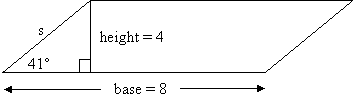
Notice that the side s is the hypotenuse of a right triangle with an angle of 41° opposite the height which is 4. We can use this relationship to find the length of side s as follows:
This allows us to find the perimeter which is the sum of the four sides, two bases of length 8 and two sides of length 6.097.The perimeter is 28.194The area is easy to find since we have the base and height.Area = bh = (8)(4) = 32Once again, a diagram is helpful because it clearly showed the right triangle which allowed us to find the length of the side s.

 The base of a parallelogram is 15 and the height is 10. What are the area and perimeter of this parallelogram?
A parallelogram has a base of 14, a height of 9, and the base makes an angle of 70° with the other side. What are the area and perimeter?
A parallelogram has a base of 3x, a height of x, and the other side of the parallelogram (not the base) is 2x. If the area of this parallelogram is 15, what is its perimeter?
The base of a parallelogram is 20 and the area is 300. What are the height and perimeter of this parallelogram?
- h = 15 and the perimeter is 75.
- h = 30 and the perimeter cannot be found.
- h = 15 and the perimeter cannot be found.
A parallelogram has a base of length 30. Another side of length 20 forms a 58° angle with this base. What are the area and perimeter of this parallelogram correct to one decimal place?
- perimeter = 100 and area = 508.8
- perimeter = 100 and area = 254.4
- perimeter = 50 and area =508.8
- perimeter = 100 and area = 707.5
A parallelogram is shown in the diagram below. If the perimeter is 38 and the area is 60, what is the height of this parallelogram?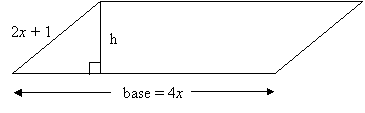
- height = 5
- height = 180/7
- height = 9/2 or 4.5
- height = 30
This type of problem involves relationships among the lengths of the sides and height as well as the area and perimeter of a parallelogram. We need to focus on two formulas: (1) area which requires a measurement of the base and height, which we call h and (2) the perimeter which is the sum of all four sides. Sometimes it is useful to remember that the opposite sides of a parallelogram are always equal. Sometimes an angle of the parallelogram is also given so that we can use one of the basic trigonometric ratios of sine, cosine, or tangent to calculate the length of the height.