Graphing Radical Functions
By M Ransom
Radical functions involve the square root of a quantity such as

where the formula for the function has a radical. Let us start with a fundamental function:
 .
The graph of this function is shown below. Note that the domain requires that
.
The graph of this function is shown below. Note that the domain requires that
 .
This is because we cannot take the square root of a negative number.
.
This is because we cannot take the square root of a negative number.
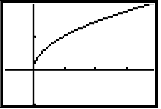
To graph the function
 ,
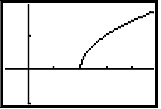
we note that this is a translation of the graph of
,
we note that this is a translation of the graph of

2 units to the right. The domain is
 .
The graph is shown below.
.
The graph is shown below.
Similarly,
 is
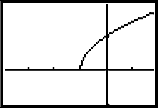
is  translated 1 unit to the left. The domain is
 .
The graph is shown below.
.
The graph is shown below.
The fundamental graph of

is a portion of the graph of
 .
If
.
If
 ,
then
,
then
 .
The graph of
.
The graph of

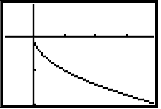
is shown below. This is a reflection of across the x-axis.
Using the principles of translation and reflection, we can graph various functions involving radicals. Some examples are shown below.
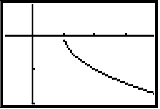
#1. Let
. This is our fundamental function
translated 1 unit to the right and then reflected across the x-axis. The domain is
. The graph is shown below.
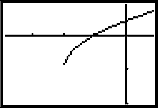
#2. Let
. This is our fundamental function
moved 2 units to the left and then 1 unit down. The domain still depends upon keeping what is under the radical from being negative. Thus the domain is
. The graph is shown below.
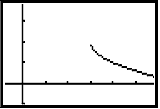
#3. Let. This is our fundamental function
moved 3 units right, reflected across the x-axis, and then moved 2 units up. The domain is
. The graph is shown below.
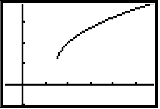
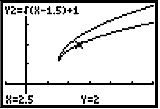
#4. Let. This is still a variation of our fundamental function
. The domain requires that
. The graph shows the characteristic radical curve increasing from the point
. The graph is shown below left. The graph shown below on the right compares this to
so that we can see the effect that the coefficient 2 of x has on the graph. The coefficient of 2 forces the graph to increase more rapidly.




Directions and/or Common Information:



Advertisement