Transformations of Exponential Functions
By S Taylor
The basic graph of an exponential function in the form

(where a is positive) looks like
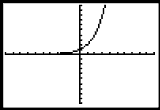
For a review of basic features of an exponential graph, click here. But what would happen if our function was changed slightly? Suppose we have the function
. The calculator shows us the following graph for this function.
The graph of our exponential has been moved up three spaces.
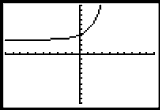
Summary: In general, when we have an exponential in the form  then the graph will be moved up or down k units.
What happens if we make a change to the exponent in our exponential function? Look at the graph of
.
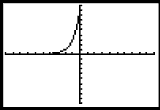
This graph has been shifted to the left 2 spaces.
Summary: A left or right shift is what happens when we make a change to the exponent. In general, if we have the function  then the graph will be moved left c units if c is positive and right c units if c is negative. If a negative is placed in front of an exponential function, then it will be reflected over the x-axis.
These are the same rules discussed for transforming quadratic graphs, they just look a little different when applied to exponential functions. But the effect is still the same.
To practice with an EXCEL model of these graphs, click here.
Directions and/or Common Information:
Use the rules of moving graphs left, right, up, and down to make a conjecture about what the graph of each function will look like. Then, graph each function.



Advertisement