Graphing Absolute Value Functions
By S Taylor
To see what the graph of y = |x| looks like, let’s create a table of values.
| x | y |
| -3 | 3 |
| -2 | 2 |
| -1 | 1 |
| 0 | 0 |
| 1 | 1 |
| 2 | 2 |
| 3 | 3 |
To graph these values, simply plot the points and see what happens.
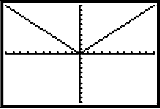
Whenever you have an absolute value graph, the general shape will look like a “v” (or in some cases, an upside down “v” as we will see later).
Let's Practice:
- Graph y = |x+2|
- Graph y = |x| - 4
- Graph y = -|x|
We know what the general shape should look like, but let’s create a table of values to see exactly how this graph will look.
| x | y |
| -3 | |-3 + 2| = |-1| = 1 |
| -2 | |-2 + 2| = |0| = 0 |
| -1 | |-1 + 2| = |1| = 1 |
| 0 | |0 + 2| = |2| = 2 |
| 1 | |1 + 2| = |3| = 3 |
| 2 | |2 + 2| = |4| = 4 |
| 3 | |3 + 2| = |5| = 5 |
So our graph of y = |x + 2| looks like
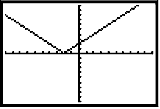
Notice that the graph in this example looks almost identical to the graph of y = |x| except that it was shifted to the left 2 units. This will be important as we try to make generalizations later in the lesson.
The table of values looks like this:
| x | y |
| -5 | 5 - 4 = 1 |
| -4 | 4 - 4 = 0 |
| -3 | 3 - 4 = -1 |
| -2 | 2 - 4 = -2 |
| -1 | 1 - 4 = -3 |
| 0 | 0 - 4 = -4 |
| 1 | 1 - 4 = -3 |
Which makes the graph look like this:
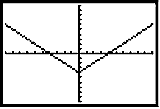
Notice that the graph in this example is the same shape as except that it has been moved down 4 units.
In creating the table of values, be careful of your order of operations. You should find the absolute value of x first and then change the sign of that answer.
| x | |x| | y |
| -3 | 3 | -3 |
| -2 | 2 | -2 |
| -1 | 1 | -1 |
| 0 | 0 | 0 |
| 1 | 1 | -1 |
| 2 | 2 | -2 |
| 3 | 3 | -3 |
So the graph of looks like:
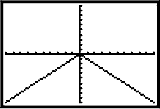
In this example, we have the exact same shape as the graph of y = |x| only the “v” shape is upside down now.
Based on the examples we’ve seen so far, there appears to be a pattern when it comes to graphing absolute value functions.
- When you have a function in the form y = |x + h| the graph will move h units to the left.
When you have a function in the form y = |x - h| the graph will move h units to the right.
- When you have a function in the form y = |x| + k the graph will move up k units.
When you have a function in the form y = |x| - k the graph will move down k units.
- If you have a negative sign in front of the absolute value, the graph will be reflected, or flipped, over the x-axis.
Keep in mind that you can also have combinations that change the absolute value graph more than once. You can practice these transformations with this EXCEL Modeling worksheet.
Directions and/or Common Information:
Graph each of the following functions. You should try to use the rules shown above, but if you want to check yourself, make a table of values to make sure you are on the right track.y = |x - 3|
y = |x + 1| - 3
y = -|x| + 2
y = |x - 2| + 1
y = -|x + 4|
y = |x - 1| + 3
Advertisement