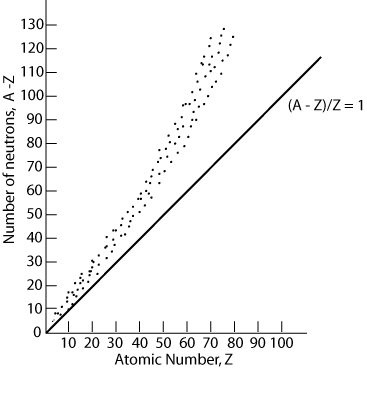
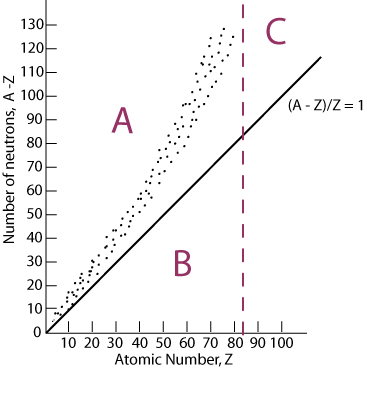
Most elements have isotopes. For stable isotopes, an interesting plot arises when the number of neutrons is plotted versus the number of protons. Because the plot shows only the stable isotopes, this graph is often called the Nuclear Belt of Stability. The plot indicates that lighter nuclides (isotopes) are most stable when the neutron/proton ratio is 1/1. This is the case with any nucleus that has up to 20 protons. As the atomic number increases beyond 20, a different trend becomes apparent. In this range, it appears that a stable nucleus is able to accommodate more neutrons. Stable isotopes have a higher neutron to proton ratio, rising to 1.5/1 for elements having atomic numbers between 20 and 83.
An understanding of the Belt of Stability will allow you to predict how unstable nuclides will decay. The typical modes of radioactive decay are alpha decay, beta decay and electron capture (or positron emission).
During alpha decay, the mass number of the nuclide decreases by 4 units and the number of protons decreases by 2. This type of decay is associated with heavy, unstable nuclides. Since no stable isotopes exist above atomic number 83, alpha decay stabilizes those isotopes having a Z value greater than 83 by lowering both the mass number and the atomic number. As an alpha particle is emitted, the number of neutrons and protons decreases, creating a more stable type of atom.
During beta emission, the net effect is that a neutron becomes a proton by ejecting an electron from the nucleus. The overall mass of the nuclide remains constant, since a proton and a neutron have approximately the same amount of mass. However, the result of beta decay is that the number of neutrons goes down by one while the number of protons goes up by one. The neutron/proton decreases, creating a more stable nuclide. Thus, when the n/p ratio is high, beta decay is favorable. This region corresponds to nuclides that would be found above the band of stability.
Positron particles have the same mass as an electron, but have a +1 charge. When a positron is ejected from the nucleus, the neutron to proton ratio increases. The net effect here is that a proton turns into a neutron. Another type of radioactive decay, electron capture, involves absorption of an inner shell electron by the nucleus. The electron is incorporated with a proton, creating a neutron. Again, the neutron to proton ratio increases. Both positron emission and electron emission occur to nuclides that are found below the band of stability.