Physics Graphs: Projectile Motion
By T Rades
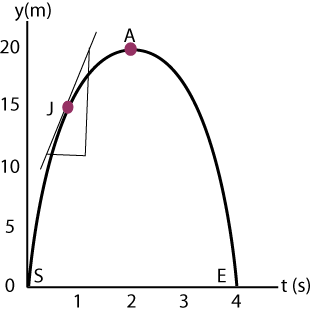
How far horizontally from its initial position does the projectile land?
What is the velocity at point A?
Is the projectile being accelerated as it passes through point A?
Our graph of altitude vs. time is a parabola with symmetry about t = 2 seconds. If the altitude at J (1, 14.7) is 14.7 meters, what is its altitude at t = 3 seconds?
On the graph, the slope of the tangent drawn at point J represents the projectile's instantaneous velocity, vJ. To one decimal place, the lower point on the "tangent triangle" is (0.40, 12.2) and the upper point is (1.2, 20.0). Based on this coordinates, what would be our best estimate of the value of vJ?
Our graph of altitude vs. time is a parabola with symmetry about t = 2 seconds. If the instantaneous velocity at J (1, 14.7) is vJ, what is its instantaneous velocity at t = 3 seconds?
How high is position A, the apex?
What is the total distance traveled by the projectile from its initial release position to it location at t = 3 seconds?
What is the net displacement of the projectile from its initial release position to it's location at t = 3 seconds?
 to model the motion of our projectile.