Physics Graphs: Charging a Capacitor
By C Colwell
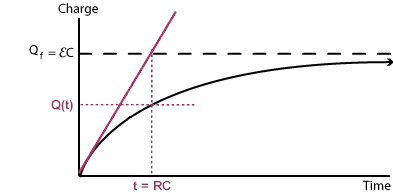
The following graph of charge vs. time represents the growth of charge (Q) on a capacitor while it is attached to a voltage source. The dotted asymptote represents the capacitor's final, or maximum allowed, charge, Qf which equals the product of the capacitor's capacitance (C) and the applied voltage ( ).
).
).
When a capacitor is placed in a circuit with a resistor, it is call an RC circuit. For every RC circuit there is a specific value known at its "RC time constant" which is equivalent to the product of the resistance in the circuit (R) the capacitance of the capacitor (C).
When a tangent line is drawn at the beginning of a capacitor's charging curve, it will intercept the asymptote representing the capacitor's final charge at t = RC.
Some units that you need to know are:
- charge (Q) is measured in coulombs
- resistance (R) is measured in ohms
- emf (
 ) is measured in volts
 - capacitance (C) is measured in farads
- time (t) is measured in seconds
If the voltage source,  , equals 120 volts and the capacitor, C, equals 100 microfarads, what is the maximum charge this capacitor can hold once the switch is closed?
, equals 120 volts and the capacitor, C, equals 100 microfarads, what is the maximum charge this capacitor can hold once the switch is closed?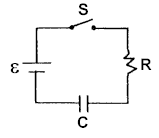
If the resistor present in our circuit is 500 kilo-ohms, what is circuit's RC time constant?
The formula used to calculate the amount of charge present on a charging capacitor at any time t, Q(t) is:

(a) Use this formula to determine how much charge will be on the capacitor after the switch has been closed for 1 RC time constant. Express your answer to 4 significant digits. (b) What percent of the final maximum charge does this represent?
(a) How much charge will be on the capacitor after the switch has been closed for 5 minutes? Express your answer to 4 significant digits. (b) What percent of the final maximum charge does this represent?
(a) How much charge will be on the capacitor after the switch has been closed for 10 minutes? Express your answer to 4 significant digits. (b) What percent of the final maximum charge does this represent?
Use your previous three answers to describe the behavior of the graph as the time spent charging the capacitor continues to increase.