Operations with Complex Numbers
By S Taylor
A complex number is of the form
 ,
where
,
where

is called the real part and

is called the imaginary part. When performing operations involving complex numbers, we will be able to use many of the techniques we use with polynomials.
Addition and Subtraction of Complex Numbers
When adding and subtracting complex numbers, we are only allowed to add real parts to other real parts, and imaginary parts to other imaginary parts.
Let's look at an example:
=
Add the real parts together.
Add the imaginary parts together.
The solution is
.
- Notice that this is a lot like adding constants and variables.




=

=
Multiplication of Complex Numbers
Multiplying complex numbers works like multiplying two binomials by using the FOIL method. Recall that FOIL means to multiply the First terms, Outside terms, Inside terms, and Last terms.
Let's look at a new example:
=
- Multiply the First terms.
- Multiply the Outside terms.
- Multiply the Inside terms.
- Multiply the Last terms.
- Combine real parts and imaginary parts.
- The solution is
.





In multiplying the last terms together we had to worry about  .
If you need to review basic facts about complex numbers, click here. (link to complex intro.doc)
.
If you need to review basic facts about complex numbers, click here. (link to complex intro.doc)

A division problem is usually given in fraction form. To solve a division problem, we will need to know the conjugate of the denominator. The conjugate is simply the same numbers of the complex number but with a different sign between them. For example, the conjugate of

is
 .
The terms are the same but with a different sign. Notice what will happen if you multiply the original number and its conjugate together.
.
The terms are the same but with a different sign. Notice what will happen if you multiply the original number and its conjugate together.

In general we say:

How will this help us with a division problem? If we multiply the denominator by its conjugate, we will obtain a real number in the denominator. However, we can’t just multiply the denominator by the conjugate because it will eliminate an imaginary number in the denominator. Whatever we do to the denominator, we must also do to the numerator. So we will multiply both the numerator and denominator by the conjugate of the denominator to solve a division problem and write our answer in standard form
( ).
).
As an example of the steps needed to complete a division problem involving complex numbers, we will simplify
.
Multiply both the numerator and the denominator by the conjugate of the denominator.
Simplify the terms.
Written in standard form the solution is:




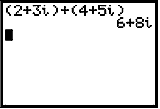
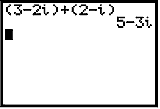
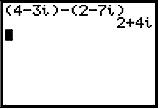
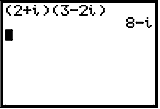
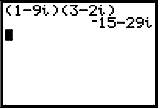
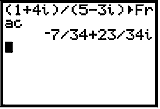
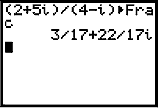
We can also use the calculator to verify the answers we got in our seven examples. To do this, the calculator has to be in complex mode. If you need help making sure your calculator is set for complex mode, click here to go to the mode lesson.
=
=
=
=
=
=
=







Advertisement